
Commercial Roofing Services
Commercial Roof Leak Repair in High Point, NC
Trace commercial roof leaks in High Point from interior staining to seams, drains, and flashing, then document the repair boundary and follow-up work.
A ceiling stain records where water became visible, not necessarily where it entered. For a High Point leak call, we start at that interior mark, check above it, and trace the likely water path through seams, penetrations, walls, and drains. The field record pairs each photograph with a roof reference point, observed moisture, and the next test needed. That gives the owner a scope tied to the assembly rather than an assumption based on the room below.
We respond to active leaks around the clock, including weekends and holidays. The first visit focuses on controlling water entry and documenting the exposed condition. Once temporary protection is stable, we separate the permanent repair from any investigation needed to locate concealed moisture.
Trace the entry route
Water can move along a deck, insulation joint, or membrane lap before reaching an interior ceiling. We examine the roof area above the stain and the details uphill from it, then compare the likely route with interior observations. Drains, scuppers, wall transitions, curb flashings, pipe boots, and open seams receive individual notes. A roof inspection can extend the investigation when several entry points are possible.
We ask about the timing of the leak, recent weather, equipment work, and any prior patch in that area. These details help prioritize where to look, but they do not replace roof evidence. If the surface looks intact, we note that result and identify whether selective testing, moisture scanning, or access to another roof section would resolve the next question.
Interior staining can remain after the roof has dried, and water can travel beyond the area of active entry. We record whether the ceiling is currently wet, whether materials need protection, and whether the observed drip changes with rainfall. The owner receives a distinction between a roof repair and interior finish work, which may require separate coordination.
Separate a leak from trapped moisture
Infrared readings, electronic scans, and visual checks answer different questions. Thermal contrast can help identify a candidate area, but an anomaly is not automatically water. We compare scan patterns with roof geometry, penetrations, known patches, and interior readings. If confirmation changes the scope, we identify the location for a selective test cut and explain what that test can establish.
The nearby Greensboro station, KGSO, records minimum temperatures at or below freezing on 68.5 days in a normal year, while 90°F highs occur on 33.3 days. These regional figures frame seasonal material movement and test timing; the roof observations determine the particular leak path. A moisture survey is useful when the owner needs a broader map than the visible drip alone.
A wet insulation finding may require removal beyond the visible stain. We map the verified area separately from the suspected area and record where additional confirmation remains outstanding. This avoids treating a broad ceiling mark as a measured roof repair quantity.
A repair matched to the assembly
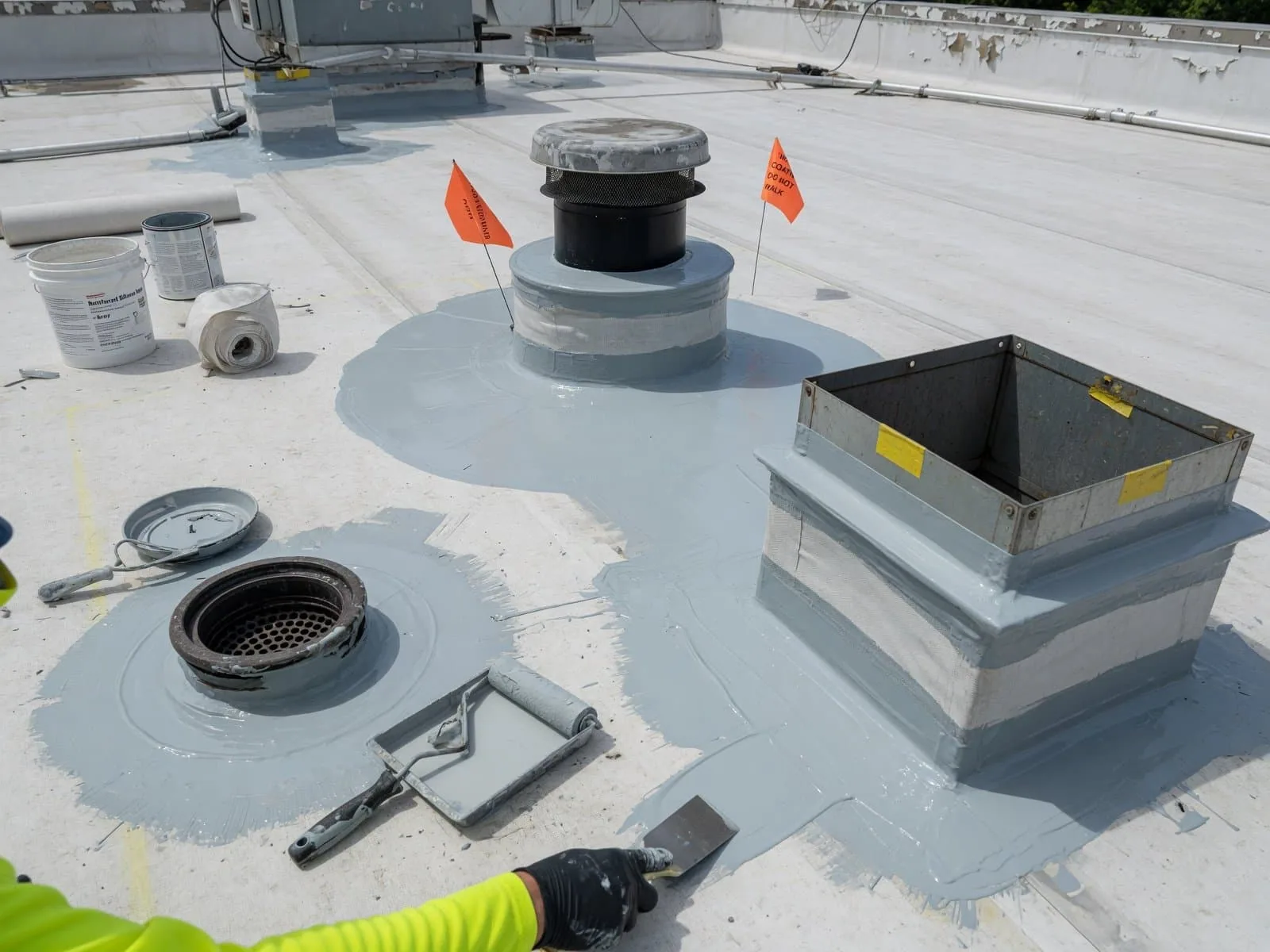
For an open seam, the scope describes the length and condition of the lap, the surface preparation, and the material used to restore continuity. At a pipe boot or curb, we inspect the flashing base and vertical termination as well as the membrane field. A commercial roof repair may include more than one detail if the water path connects them. We photograph the full repair boundary before and after the work.
Compatibility governs the repair method. Aged single-ply membranes, asphaltic roofs, metal panels, and coated surfaces do not accept the same repair material. We identify the existing construction where possible, then state any uncertainty caused by prior coatings or concealed layers. A patch that bonds only to a coating of unknown adhesion may not address the underlying failure.
If the assembly shows widespread wet insulation or repeated failures, we present broader choices such as selective replacement, restoration, or a new roof system. Those options are not substituted for emergency protection. The initial scope keeps temporary control, permanent repair, and capital work as separate decisions.
High Point conditions in the record
The EF-3 tornado that touched down in High Point on March 28, 2010 damaged more than 600 structures and destroyed 40 homes. That local history can make a post-storm leak investigation urgent, but the date alone does not prove a specific roof was damaged. We compare the building’s current condition with available photographs or prior reports and document impact marks, displaced flashings, or openings that we can actually observe.
Gallimore Industrial Center sits near Gallimore Dairy Road, I-40, and N.C. 68. A facility in this commercial area may have delivery or production timing to coordinate; our visit plan confirms those constraints with the manager. We identify roof access, staging, and any interior areas that need protection before repair begins.
On a multi-building campus such as Piedmont Centre, water entry at one address should not be generalized to another roof. We give each roof area its own photo labels, condition notes, and repair status. That makes the next inspection useful across a portfolio without implying identical assemblies.
Close the loop after the leak
The closeout record includes the original entry point, route examined, repair performed, and any suspected area left for testing. We verify the repaired detail and the nearest drainage path, then give the owner dated photographs. If a later storm produces another drip, the owner can compare the new location with the earlier work rather than starting from an undocumented ceiling stain.
For continuing oversight, a roof condition report can consolidate open leaks, completed repairs, and follow-up findings. The report distinguishes active water entry from a dry but stained interior finish. It also lists the next action, such as monitoring a seam, clearing a drain, or authorizing selective testing.
Some leaks need attention before a permanent repair can be safely completed. We record temporary materials and their intended follow-up separately. The final scope states whether the area was permanently repaired, remains under observation, or needs another trade to address interior materials.
A leak closeout should preserve the interior report and roof finding together: suite or room, date, likely path, confirmed opening, temporary action, permanent detail, and return-check status. If the source was not verified, keep that question open instead of describing a temporary patch as a full correction. When a later report occurs in the same area, compare its timing and location with the earlier record before repeating the same repair. This may reveal whether the new symptom is connected or requires a separate inspection.
If a second visit is needed, specify whether the crew is returning to check a repair, obtain access, or perform a new diagnostic step. Record who will coordinate the interior and roof access, along with any temporary measure that should remain in place until the return.
Related Roofing Work
Storm and Roof Damage Repair
Storms that reach the Triad can lift edges, open seams and crack flashing. Start here:
- Wind Damage Roof Inspection and RepairInspect High Point commercial roofs after high winds, document edge and flashing conditions, stabilize exposure, and define measured repair limits.See repair options
- Hail Damage Roof Inspection and RepairAssess High Point commercial roofs after hail, document impact evidence, select focused testing, and define measured repairs without assuming causation.See repair options
- Tornado Damage Roof Assessment and RepairAssess High Point commercial roofs after tornado damage with released access, roof-zone mapping, temporary stabilization, and staged repair records.See repair options
Roof Assessment
Trace the water path
Arrange a High Point roof visit for dated photos, a leak-path review, and a scoped permanent repair or test.
Questions About Roof Leak Repair
Can the ceiling stain show the exact roof opening?
No. Water can travel above the ceiling before it appears. We trace the path across the roof and label the observed entry point separately from the interior stain.
Will an infrared scan prove that insulation is wet?
No. A thermal pattern identifies an area for closer review. We compare it with roof conditions and recommend selective confirmation when the result would change the repair.
What if the leak returns after a patch?
We compare the new observation with the prior photographs and repair boundary. A returning leak may indicate a larger water path or a separate detail, which receives its own investigation.
Can you protect the building at night or on a weekend?
Yes. Emergency response is available around the clock. We first control active water entry, then prepare a permanent repair scope and follow-up record.
More questions? Ask our roofing team or call 555-555-5555.
Request a Roof Assessment in High Point
Send the address, the roof concern and when the roof can be reached. We walk the roof, photograph what we find and explain the repair or replacement options.
Roof Assessment
Commercial Roofing in High Point
Call, email or send the building details. We set a time to walk the roof and look at the leak, the drains and the flashing.