
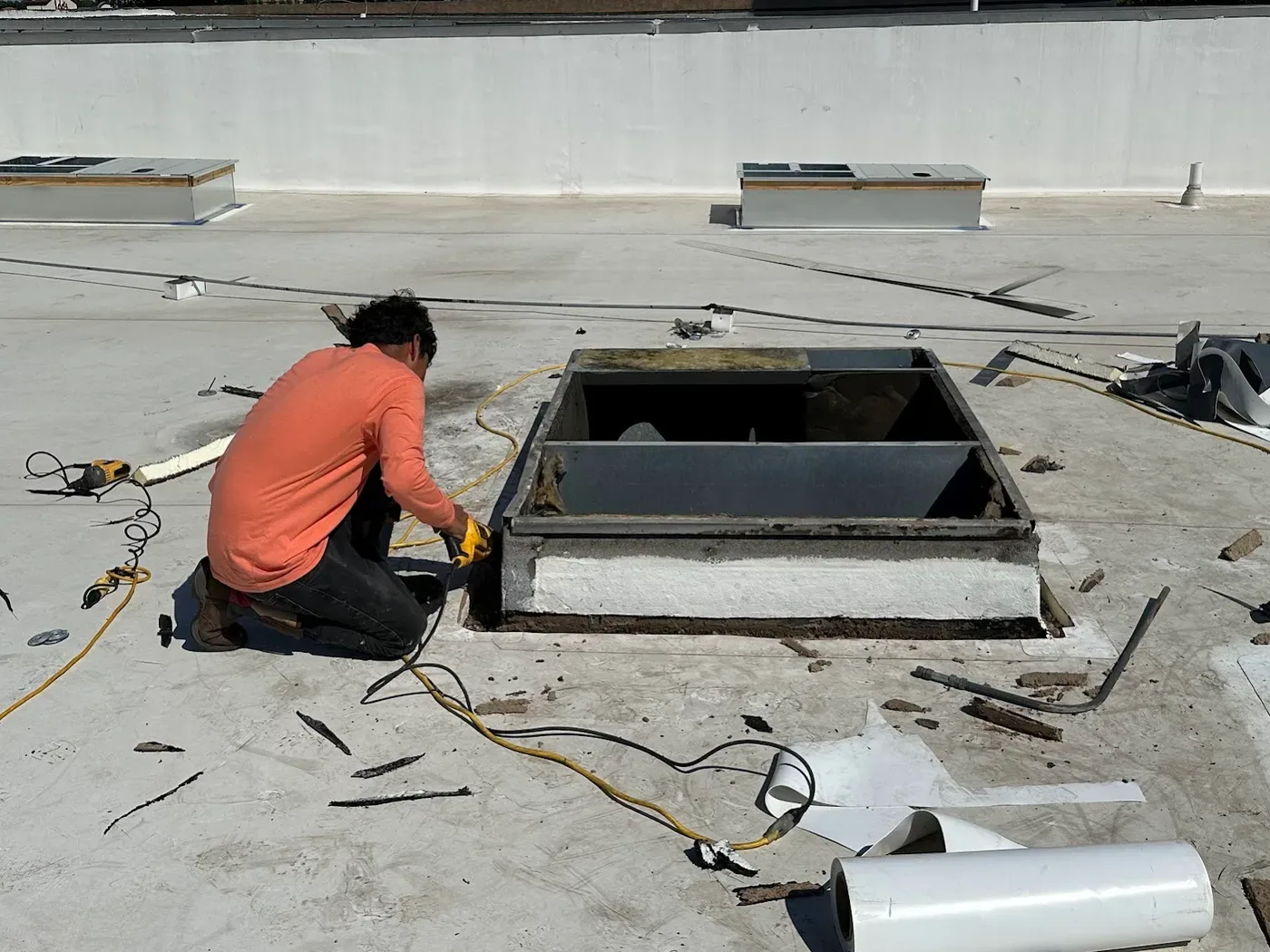
Commercial Roofing Services
Commercial Roof Repair in High Point, NC
Repair commercial roof leaks, seams, flashing, and drainage in High Point with a mapped work area, compatible materials, and a dated closeout record.
A separated seam on a High Point roof is a repair question with a boundary: how far has the opening traveled, and what has water reached below it? We photograph the break, follow adjacent laps, inspect the edge condition and drain path, then mark the area that needs work. That record helps distinguish a contained defect from membrane movement across a larger section. Our repair scopes name the observed condition, the proposed fix, and what remains outside the work.
High Point’s March 2010 EF-3 event left a sizable local damage record: the National Weather Service counted over 600 affected structures and 40 homes destroyed. After any severe-weather event, an owner may need to sort sudden impacts from pre-existing wear. A dated inspection makes that comparison practical without treating every roof as storm-damaged.
Repair the cause, not just the surface
A patch can cover a puncture while leaving a failed seam, open flashing lap, or blocked drain untouched. We inspect the material around the visible defect and note whether the surrounding surface is sound enough to receive a compatible repair. The written scope identifies preparation, patch dimensions, reinforcement, and any detail that needs separate treatment. A commercial roof inspection can expand that record when the first defect reveals a wider pattern.
Water may travel laterally above a deck before it appears indoors. We trace likely routes from the interior stain toward penetrations, wall transitions, drains, and field seams, then photograph each relevant detail. If the insulation is wet or the deck has deteriorated, a surface patch alone may not return the assembly to serviceable condition. We explain which finding supports a localized repair and where selective opening would provide better evidence.
Compatible materials matter. Different membranes, coatings, and asphaltic systems require different surface preparation and repair methods. We identify the existing system where possible before applying a repair material, and we record any uncertainty when the surface has been coated or modified. The scope avoids mixing systems by assumption.
Define the repair boundary
Each repair area is marked on a roof plan or photo key. The boundary includes enough sound material for a reliable tie-in and excludes areas that have not been inspected. At a transition, we describe the lap direction, flashing height, and nearby edge condition so the crew can reproduce the intended detail. The closeout photograph uses the same roof reference point as the initial image.
Drainage issues require a separate line of investigation. We check whether water is obstructed by debris, a damaged drain bowl, a disconnected leader, or a low area in the roof plane. A repair can restore a drain transition, but it does not remove a structural cause of deflection. If water remains after routine drainage clears, we document the ponding area and recommend the next measurement or correction instead of applying a cosmetic patch.
At a large campus such as Piedmont Centre, roof areas may differ in age and assembly. Each repair needs a property-specific record that names the building and roof section. An owner can then prioritize a recover option or replacement for a different area without bundling every roof into one repair ticket.
System-specific repair work
On a single-ply roof, we examine seam width, weld quality, membrane movement, attachment, and the condition of the substrate around the failure. A compatible patch must extend to sound material and be sealed without trapping debris or moisture. For TPO roof work, the repair method follows the membrane condition and manufacturer requirements for cleaning and welding. Aged or contaminated surfaces may require a different preparation plan than a newer, clean sheet.
Modified-bitumen and built-up systems need attention to blistering, splits, gravel or cap-sheet condition, and flashing transitions. Metal roofs call for a look at fasteners, seams, panel movement, closures, and exposed sealant. Coatings are not a universal repair layer; we first determine whether the substrate and existing coating are compatible and bonded. A modified-bitumen assembly review can help frame a larger restoration decision.
Repair access is also part of the method. We identify the route to the work area, any equipment that must be protected, and whether a controlled work zone is needed below. Material staging is limited to approved areas, and the closeout record notes any temporary protection removed when the repair is complete.
Weather and property context
NOAA normals at nearby Greensboro (KGSO) include 33.3 days per year with highs of at least 90°F and 68.5 days with freezing minimums. These Greensboro station normals frame regional exposure; the inspection records conditions on the building. They help frame material movement and maintenance timing, while the roof inspection determines whether a seam or flashing has actually failed.
Gallimore Industrial Center is an 82-acre industrial park along Gallimore Dairy Road near I-40 and NC 68. Its local employers include HandCraft Linen Services, LLFlex, Carpigiani, and Pella Windows & Doors. Confirm delivery windows and work hours with the property contact.
A local severe-weather history can support a careful post-event review. We compare new photographs with any available baseline, mark observed impacts, and separate visible mechanical damage from older deterioration. If the evidence supports only a small repair, the scope stays small. If several areas show related failures, we propose a broader investigation with clear decision points.
Record the result
After the repair, we photograph completed seams, flashings, perimeter details, and repaired penetrations from consistent reference points. The record lists the materials used, roof area, observed conditions, and any follow-up items. That information is useful when the next storm or maintenance visit changes the roof condition. A dated condition report can keep the repair tied to a larger asset history.
If the repaired area remains dry and stable through follow-up inspection, the owner has evidence to close the item. If movement, moisture, or a second failure appears, the new observation can be compared with the repair boundary. The next scope can then address the actual change instead of repeating the original diagnosis.
We provide around-the-clock emergency response when a failure cannot wait for normal scheduling. Once immediate water entry is controlled, the permanent repair still receives its own documented scope and closeout record. Temporary protection and permanent work are tracked separately so the owner knows what has been completed.
The repair record should name what would reopen the diagnosis: moisture beyond the patch, movement at a nearby joint, a repeated stain after rain, or a new condition at the drain transition. A scheduled check can verify the repaired boundary after normal building operation. If no new water appears, retain that result with the original photos and work order.
Related Roofing Work
Storm and Roof Damage Repair
Storms that reach the Triad can lift edges, open seams and crack flashing. Start here:
- Wind Damage Roof Inspection and RepairInspect High Point commercial roofs after high winds, document edge and flashing conditions, stabilize exposure, and define measured repair limits.See repair options
- Hail Damage Roof Inspection and RepairAssess High Point commercial roofs after hail, document impact evidence, select focused testing, and define measured repairs without assuming causation.See repair options
- Tornado Damage Roof Assessment and RepairAssess High Point commercial roofs after tornado damage with released access, roof-zone mapping, temporary stabilization, and staged repair records.See repair options
Roof Assessment
Set a repair boundary
Arrange a High Point roof walk for dated photographs, measurements, and a scoped repair or investigation.
Questions About Roof Repair
How do you tell whether a patch will hold?
We check the membrane around the opening, confirm compatible repair materials, and extend the tie-in to sound substrate. If damage continues beyond that boundary, the scope identifies the added area.
Can a roof leak be repaired without replacing the whole roof?
Yes, when the failure is localized and surrounding assembly remains serviceable. We map the repair area and note any evidence that would support a larger option.
What happens if water is still ponding after the repair?
We inspect the drain path and measure the affected area. If the ponding comes from slope or deck deflection, that correction is scoped separately from a membrane patch.
Do you respond outside normal business hours?
Yes. Emergency response is available around the clock, every day. We first document and control active water entry, then define the permanent repair and its closeout record.
More questions? Ask our roofing team or call 555-555-5555.
Request a Roof Assessment in High Point
Send the address, the roof concern and when the roof can be reached. We walk the roof, photograph what we find and explain the repair or replacement options.
Roof Assessment
Commercial Roofing in High Point
Call, email or send the building details. We set a time to walk the roof and look at the leak, the drains and the flashing.