Commercial Roofing Services
Infrared Roof Moisture Survey in High Point, NC
Map candidate roof moisture in High Point with infrared and visible images, confirmed test locations, documented limits, and repair-ready next steps.
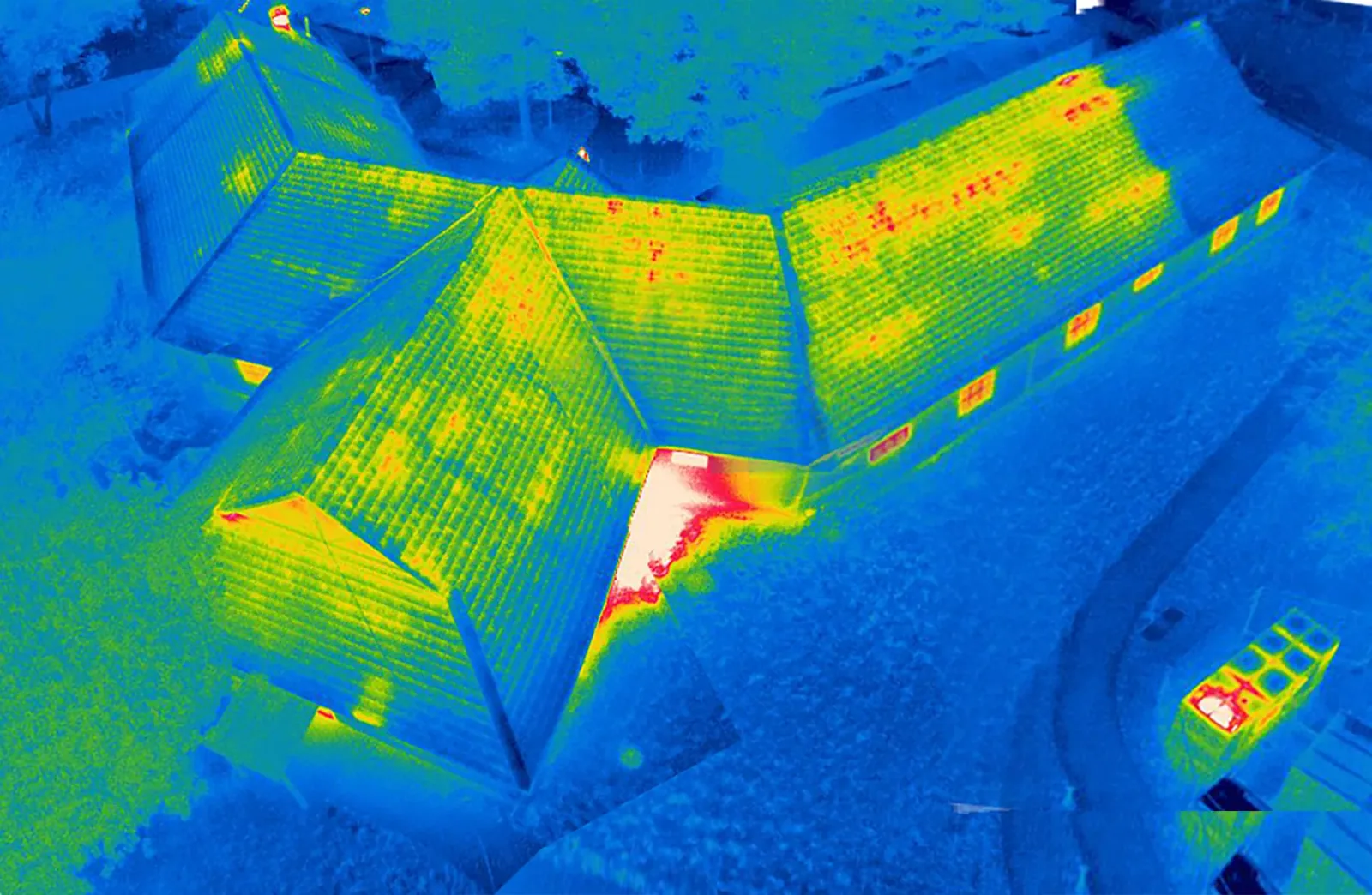
A warm roof patch after sunset can be a candidate for moisture, but a thermal image does not identify water on its own. In High Point, our infrared moisture survey maps temperature patterns, compares them with the roof layout, and marks locations that deserve confirmation. We record the survey conditions, instrument settings, and area boundaries so the owner can understand how the map was produced. The final recommendation distinguishes a thermal anomaly from a verified wet assembly.
NOAA normals at Greensboro (KGSO) show warm-season highs of at least 90°F on 33.3 days per year and freezing minimums on 68.5 days. These regional figures help explain seasonal temperature swings; the actual survey depends on surface conditions, recent weather, roof construction, and sufficient thermal contrast.
Build a usable thermal map
Before scanning, we review the roof type, insulation arrangement when known, drainage, recent rain, shade, rooftop equipment, and access. We select the survey timing to capture useful thermal contrast and note factors that can distort readings. Wetness beneath a membrane may retain heat differently than dry material, but solar gain, insulation changes, air movement, and mechanical equipment can also produce patterns.
We scan and label roof areas consistently, then compare the image with visible drains, seams, walls, curbs, and interior observations. The report uses candidate areas rather than declaring every temperature difference to be moisture. If a pattern continues across a roof section, we determine whether a selective test cut or other confirmation is needed before setting repair quantities.
A drone roof survey can provide an overhead map of difficult-to-access areas, while infrared equipment records thermal variation. The methods answer different questions. Neither one replaces a hands-on review of a suspicious flashing, seam, or penetration.
Separate anomalies from confirmed moisture
A thermal anomaly is a location for review, not a diagnosis. We compare its shape and location with the roof assembly and expected heat paths. A dark patch near a drain may reflect a different substrate or shade; a regular pattern may align with insulation boards or fasteners. We explain plausible causes and mark what additional observation would distinguish them.
Confirmation may involve an interior check, an electronic scan, or a selective opening. We identify the candidate area and the reason to test it. If test results show wet insulation, we measure the confirmed boundary and separate it from nearby areas that remain uncertain. The report preserves this distinction so an owner does not budget the entire thermal image as replacement quantity.
For leak investigation, we combine thermal information with roof-level details and interior history. A leak-path investigation may show whether an anomaly aligns with active entry. A roof inspection provides direct observations of seams, flashings, drains, and surface condition that an infrared image cannot capture.
Survey context in High Point
The EF-3 tornado that reached High Point in 2010 is part of the city’s severe-weather record. After water intrusion, thermal mapping can show candidate wet areas; a temperature pattern alone cannot date damage or assign its cause. We compare imagery with visible openings, interior reports, and prior roof records before describing a condition as new.
High Point North Industrial Center is in northwest High Point, while Gallimore Industrial Center sits near I-40 and N.C. 68. These places provide local building and transportation context, not a common roof assembly. For a specific warehouse or campus, we first obtain access, map the roof sections, and identify operating constraints with the property contact.
Piedmont Centre includes more than 170 companies across a large business campus. A property manager handling several buildings can use a consistent map key to compare survey results, while the findings remain specific to each roof. A Piedmont Centre roof record is not generalized to another address without a separate survey.
Connect findings to the work scope
When confirmed moisture is localized, we mark its measured boundary and review whether the adjacent assembly is dry and serviceable. The scope can then address insulation removal, replacement, membrane repair, and tie-in detail in the affected area. A repair option remains separate from broad replacement unless testing indicates more extensive failure.
If moisture is widespread, repeated, or paired with unstable layers, a recover or replacement analysis may be more useful than scattered patches. We show what was confirmed and what remains untested. The owner can authorize another sample area if the result would materially change the project choice. Test locations and results are labeled for future reference.
Survey cost and schedule depend on roof access, building size, weather, thermal conditions, and the number of confirmation tests. We state which areas were captured and any section omitted for safety or obstruction. An image without a marked boundary is hard to compare, so the deliverable includes a map or photo key and explanatory notes.
Preserve the survey record
The report includes thermal images, corresponding visible-light photographs, labeled locations, survey date and conditions, candidate anomalies, confirmed test results, and recommended next steps. We retain original files when available and keep the annotated set with the building record. A roof condition report can carry those findings into repairs or later monitoring.
If the owner authorizes follow-up testing, the new locations are compared with the original map. A later survey should note changed roof surfaces, new equipment, coatings, weather, or other factors that affect comparability. We do not present two images as direct proof of improvement unless survey conditions and confirmation support that conclusion.
During owner review, we walk the map from roof section to candidate location and explain which observations are measured, which are confirmed, and which remain open questions. The review can include maintenance staff who know where prior repairs or equipment changes occurred. Those records may help explain a thermal pattern, but we verify the roof condition before changing the recommendation. The next action may be a test opening, a targeted repair, or observation at a planned interval. We connect each choice to the evidence and document the selected path. That lets an asset manager explain why the work was authorized and where the confirmed moisture was addressed.
An infrared survey should be scheduled under conditions suitable for the selected method and interpreted alongside roof construction details. Define the scan boundary, recent weather context, areas blocked from view, and locations proposed for verification. Thermal patterns are indicators, not standalone proof of wet insulation. The report should identify anomalies and the next confirming step, such as targeted cores, then record sample results separately. This lets the owner use the survey to focus investigation without authorizing removal based solely on an unverified image pattern.
For repeat surveys, keep the scan boundary and image labels consistent. Note recent weather, surface shade, equipment operation, and any coating or repair added since the prior visit. Those details help separate a real change from a difference in survey conditions.
Related Roofing Work
Storm and Roof Damage Repair
Storms that reach the Triad can lift edges, open seams and crack flashing. Start here:
- Wind Damage Roof Inspection and RepairInspect High Point commercial roofs after high winds, document edge and flashing conditions, stabilize exposure, and define measured repair limits.See repair options
- Hail Damage Roof Inspection and RepairAssess High Point commercial roofs after hail, document impact evidence, select focused testing, and define measured repairs without assuming causation.See repair options
- Tornado Damage Roof Assessment and RepairAssess High Point commercial roofs after tornado damage with released access, roof-zone mapping, temporary stabilization, and staged repair records.See repair options
Roof Assessment
Map and verify moisture
Arrange an infrared roof survey in High Point for labeled thermal images, confirmation points, and a scoped next step.
Questions About Infrared Roof Moisture Survey
Does a thermal image prove the roof is wet?
No. It shows temperature variation that may have several causes. We label candidate areas and recommend confirmation when that result would change the scope.
What conditions make the survey useful?
The roof needs sufficient thermal contrast and safe access. Recent weather, shading, equipment, and roof construction can affect interpretation, so we document those conditions.
Will you make test cuts?
We identify locations where selective confirmation may answer an important question. Test cuts are scoped and approved separately, then mapped with the findings.
Can this survey find the source of an active leak?
It can help locate candidate wet areas, but the water path and entry detail require roof inspection. We compare thermal patterns with drains, seams, flashings, and interior evidence.
More questions? Ask our roofing team or call 555-555-5555.
Request a Roof Assessment in High Point
Send the address, the roof concern and when the roof can be reached. We walk the roof, photograph what we find and explain the repair or replacement options.
Roof Assessment
Commercial Roofing in High Point
Call, email or send the building details. We set a time to walk the roof and look at the leak, the drains and the flashing.