
Roof Damage Repair
Commercial Hail Damage Roof Inspection and Repair in High Point, NC
Assess High Point commercial roofs after hail, document impact evidence, select focused testing, and define measured repairs without assuming causation.
Hail can mark a commercial roof without producing a visible leak, and a leak after a storm does not by itself establish hail as the cause. A useful assessment maps impact observations, confirms the roof materials, checks related flashings and rooftop components, and identifies areas that were not accessible. We document what is visible and distinguish it from reported event timing or a claim conclusion.
The National Weather Service's 2010 High Point severe-weather summary describes large hail in the regional storm sequence. That establishes hail as a documented area exposure, not damage at a specific building. The current roof inspection must rely on site evidence and the building's available history.
Secure access and preserve the initial condition
Before inspection, confirm roof access, weather conditions, and any safety concern from debris or active leaks. Photograph the affected roof areas before cleanup when practical. If loose material or broken rooftop components could injure someone, the property controls access and arranges the appropriate safe handling.
For active water entry, interior protection and temporary roof stabilization may be needed. A temporary response should document the location and materials used; it does not establish the final hail-related repair area. A subsequent roof survey can inspect accessible seams, edges, penetrations, and drains after the site is safe.
Keep removed debris or samples only when the owner or claim professional requests preservation. Record who collected an item and where it came from.
Compare impacts across the roofing system
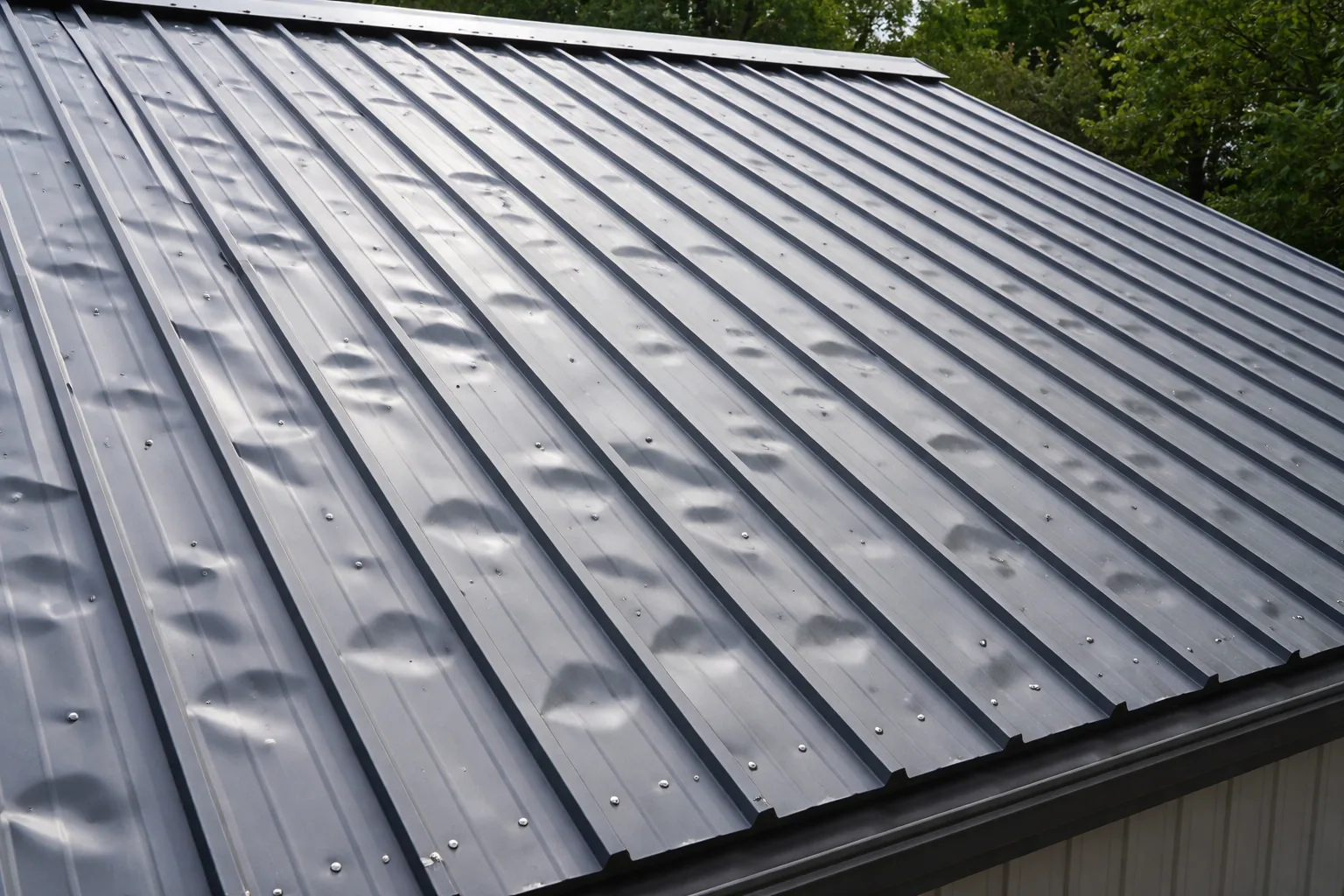
Map any dents, fractures, granule loss, coating marks, membrane cuts, displaced flashings, or damaged accessories. Use broad photos to show distribution and close images for each observation. Note whether the mark is on a roof surface, metal coping, rooftop unit, skylight, or a separate building component. A qualified roofing inspection should not infer damage to components outside its scope.
Compare similar roof zones when a building has different exposures, elevations, or assemblies. Hail impact can appear differently on membranes, metal, coatings, and rooftop equipment, so avoid applying one observation to every material. A leak assessment should trace any interior report to an observed opening where possible.
Existing wear, maintenance traffic, debris, and older repairs can resemble event-related marks. Available pre-event images or service records may help establish what changed, but their date and coverage should be noted.
Choose focused testing when evidence is unclear
Some impact marks may not reveal whether the membrane was punctured or whether insulation became wet. Testing should answer a defined question, such as confirming material integrity or mapping suspected moisture. An infrared scan can guide test locations but does not confirm hail causation. A test opening should have an agreed location, size, repair method, and owner authorization.
If the roof is coated or granulated, document where coating or surfacing is disturbed and whether the substrate is visible. If equipment housings show dents, the equipment provider may need to inspect internal operation. The roofing report should identify those handoffs without diagnosing machinery.
Record non-testable areas as limits. A result at one point applies to that location and method; it should not be represented as a roof-wide condition unless the inspection plan supports that conclusion.
Before testing, identify who will observe the opening and what evidence must be captured for the owner. Photograph undisturbed surfacing, the exposed layer, and any moisture encountered. If the test is intended to compare an impact mark with a control area, choose the second location deliberately and note the reason. The test contractor should repair each opening using a method compatible with the confirmed roof system.
Scope repair, restoration, and replacement separately
A repair proposal lists confirmed impact points, materials, preparation, dimensions, and any accessory or flashing work included. If damage is limited, a measured repair may preserve unaffected roof areas. Where the assembly shows broader deterioration, compare repair with restoration or replacement using separate quantities and assumptions.
A roof repair scope should not combine hail observations with unrelated maintenance unless each item is identified. A replacement alternative should state tear-off, insulation, deck, edge, temporary protection, and access assumptions. Before a recovery option is proposed, verify moisture, attachment, drainage, deck capacity, edge height, code, and system approvals.
Claim reviewers may require a different documentation format. Confirm photo labels, estimate basis, and whether removed samples should be retained, while keeping construction scope distinct from coverage opinions.
Estimate documentation should separate mobilization, access, testing, temporary protection, and permanent repair. If pricing assumes a certain number of impact points, list each point or describe a measurable unit. State what changes if additional damage is found after the first repair is opened. The owner can then approve an expanded scope based on newly visible conditions rather than an undefined contingency.
Tie event context to the correct High Point building
City mapping identifies Piedmont Centre and Premier Center as separate local business areas. These place names can guide dispatch, but do not identify a particular occupant or show that a roof received hail. Record the inspected address, facility contact, asset name, and exact roof zone in the report.
For multiple sites, keep event date and observations separate in each file. A regional storm report does not establish equal hail intensity at every property. Where available, compare owner-supplied prior photos, maintenance visits, and reported leak timing with the current inspection.
If the storm also involved high winds, document edge or flashing movement as a separate finding. A wind damage review addresses those conditions without merging them into a hail conclusion. If the inspection confirms a membrane opening, a puncture repair can define that separate detail.
Provide a defensible photo and repair record
Closeout should include inspection date, reported event date, marked roof plan, image labels, areas reached, conditions observed, test results, measured repair, and remaining recommendations. Identify whether a conclusion is based on visual inspection, physical test, or a record supplied by another party. This helps the owner and claim professional evaluate the evidence.
After repair, keep before-and-after photographs from the same roof zone and list any adjacent impact area left outside the work. If the repair is temporary or limited pending testing, state that status plainly and assign the next decision. Do not use a completed patch as proof that all reported impact was addressed.
Request an assessment after a hail report when the roof has visible surface changes, new water entry, or a pending repair decision. We provide measured roofing observations and a clear scope boundary.
Keep an unedited original set when requested, then use copies for labeled reports. Identify the photographer, capture date, and roof location. Where a close-up lacks scale, add a follow-up image with a ruler or reference object rather than altering the original photograph.
Preserve the image labels with the final estimate revision and file the estimate, event date, inspection date, and roof plan under the same asset record. That gives the next reviewer a clear chain from reported event to observed condition and approved work.
Related Roofing Work
Storm and Roof Damage Repair
Storms that reach the Triad can lift edges, open seams and crack flashing. Start here:
- Wind Damage Roof Inspection and RepairInspect High Point commercial roofs after high winds, document edge and flashing conditions, stabilize exposure, and define measured repair limits.See repair options
- Hail Damage Roof Inspection and RepairAssess High Point commercial roofs after hail, document impact evidence, select focused testing, and define measured repairs without assuming causation.See repair options
- Tornado Damage Roof Assessment and RepairAssess High Point commercial roofs after tornado damage with released access, roof-zone mapping, temporary stabilization, and staged repair records.See repair options
Roof Assessment
Document hail observations before selecting a repair
Arrange a High Point hail roof inspection with labeled photographs, area mapping, and a repair or testing recommendation.
Questions About Hail Damage Roof Inspection and Repair
Does a regional hail report confirm damage to my roof?
No. It provides event context only. The building must be inspected and documented before site-specific damage is described.
Can hail damage exist without an immediate leak?
Yes. A roof material or accessory may show an impact without current water entry. The report describes the observation and any follow-up test recommended.
Will infrared testing prove hail caused a leak?
No. Infrared can help locate possible moisture patterns. Physical inspection and other evidence are needed to evaluate the condition and cause.
Can you prepare a repair estimate for a claim?
We can provide a measured roofing scope and supporting photographs. Coverage and settlement remain decisions for the insurer and authorized claim parties.
More questions? Ask our roofing team or call 555-555-5555.
Request a Roof Assessment in High Point
Send the address, the roof concern and when the roof can be reached. We walk the roof, photograph what we find and explain the repair or replacement options.
Roof Assessment
Commercial Roofing in High Point
Call, email or send the building details. We set a time to walk the roof and look at the leak, the drains and the flashing.