
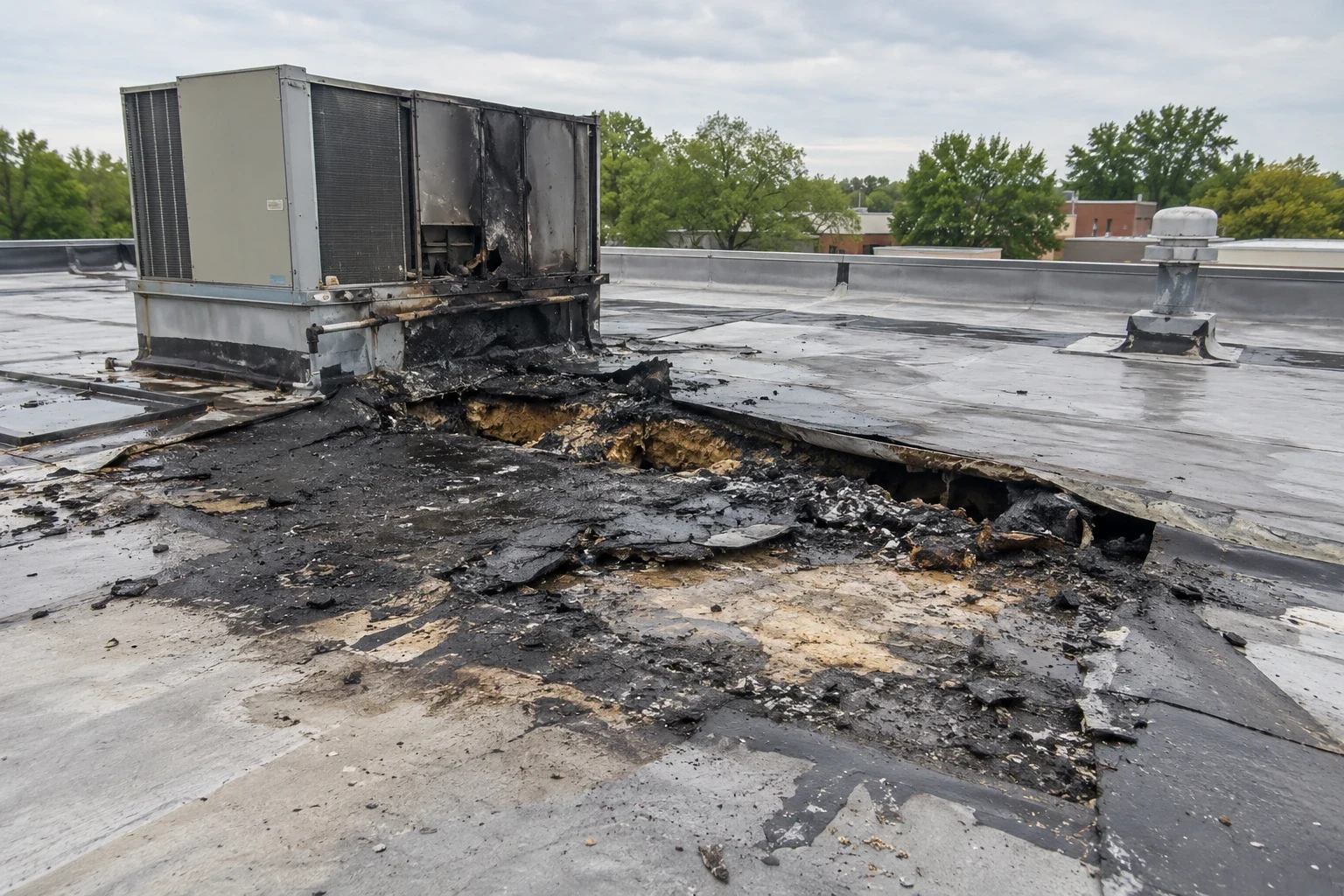
Roof Damage Repair
Commercial Fire Damage Roof Inspection and Repair in High Point, NC
Assess High Point commercial roofs after fire, coordinate released access, document heat and water conditions, and scope safe stabilization or repair.
After a commercial building fire, the roof assessment must account for direct heat, suppression water, debris, access restrictions, and any structural evaluation underway. The roofing inspection records visible membrane, deck, flashing, and penetration conditions within the areas authorized for entry. It does not replace the fire investigator, structural engineer, or hazardous-material professional.
High Point includes Piedmont Centre, a business park with more than 1,100 acres and over 170 companies, and Premier Center, a separate 150-acre office park across NC 68. These broad commercial areas help route service calls; the incident address, safety release, and building records determine the roof inspection.
Wait for site release and define safe access
Do not enter a fire-affected roof until the authority having jurisdiction and property safety contact permit access. Hot spots, damaged deck, unstable parapets, electrical hazards, and contaminated debris may remain after visible flames are out. Confirm which zones are open, what protective equipment is required, and which specialist controls the site.
If water intrusion remains active and access is approved, document the temporary measure and who authorized it. A roof stabilization response can protect an exposed area, but it does not determine structural capacity or the extent of smoke contamination. Record the limits of every inspection area.
Coordinate interior entry with the property manager and safety lead. A roof condition assessment follows only after the site has been cleared for the planned inspection method.
Separate heat, impact, and water conditions
Map visible blistering, membrane shrinkage, melted or displaced components, damaged edge metal, debris impact, wet insulation, and open penetrations. Photograph both broad context and individual details. Separate direct heat evidence from suppression water and from pre-existing wear where the record supports those distinctions. If the cause or extent is uncertain, state that limitation.
Fire and suppression activity can affect layers beyond the visibly charred surface. Test openings may be needed to inspect deck, insulation, and attachment, but only after authorization and safety review. An infrared scan can help target locations when appropriate; it cannot determine fire damage by itself.
Interior reports should identify room or asset and time observed. A leak assessment should not attribute water to a roof opening until accessible roof evidence supports the connection.
Preserve photographs from before debris removal when possible, with an orientation and scale. If material must be moved for safety, note who moved it, when, and where it was placed. Do not label soot, blistering, or discoloration as a specific chemical or fire effect without appropriate evidence. The owner may need a specialist to identify contamination or determine whether building contents can be returned.
When residue or debris is present, identify the area inspected without disturbing material outside the approved work zone. The fire investigator or environmental specialist may need to preserve samples or document a chain of custody. The roofing scope should state whether cleaning, removal, and disposal are excluded, so no one mistakes a roof repair price for full remediation.
Stabilize exposure before permanent restoration
A temporary cover or dry-in may be necessary to limit further water entry. The plan identifies the area covered, attachment, expected duration, monitoring contact, and conditions that require a return visit. Consider wind exposure, remaining structural questions, and the need to keep the cover clear of fire-system or ventilation equipment.
Permanent work waits until the owner and qualified reviewers define what can remain. A repair proposal should identify removed material, confirmed deck conditions, moisture boundaries, and roof details to restore. A replacement scope may need to separate fire-affected zones from unaffected roofs and include additional testing before quantities are final.
Do not mix mitigation, debris removal, hazardous-material handling, structural repairs, and roofing installation into one undefined scope. Assign each trade and approval path clearly.
Review the temporary detail after installation and after any severe weather under the approved monitoring plan. Record whether water is still entering and whether the cover remains secure. A temporary assembly should not obstruct roof drains, fire protection components, exhaust discharge, or required access routes.
Temporary protection may need staged access if crews cannot reach all affected areas on the first visit. Mark covered sections on the plan, photograph attachment points, and identify the party responsible for checking the cover between visits. If conditions change and the cover must be adjusted, record the date and reason.
Suppression water can enter through openings that are separate from the fire-damaged area. Protect exposed interiors, map each temporary cover, and note which sections remain unsafe or inaccessible. A later inspection can then compare the same roof zones after debris removal and structural review.
Keep each High Point site record separate
Premier Center is a 150-acre office park, while Piedmont Centre spans more than 1,100 acres and supports over 170 companies. Use the property's verified name and address to identify the affected structure and roof zone.
For multiple buildings, distinguish every roof and access status. One released roof does not mean adjacent structures or connecting canopies are safe. Keep incident photographs and contractor records linked to the correct asset and date.
Where a fire damages a membrane opening, a puncture review can document that particular condition once access is safe. A tornado damage assessment may be relevant only when that event type is reported and physical evidence is reviewed. If heat affects a coated assembly, assess that separately from direct flame damage.
Prepare the restoration handoff
The file should include the inspection authorization, access limits, incident date as reported, marked roof plan, dated photographs, observed materials, tests performed, work completed, and open review items. Label reports from engineers or fire investigators by author and date; do not merge their conclusions into the roofing contractor's observations.
Before permanent installation, reconcile the approved scope with test results and the owner's direction. At completion, document new materials, tie-ins, repaired area, weather conditions, and any remaining temporary work. State which zones were not included or could not be inspected.
Request a roof assessment after a fire only when the authority permits access and the relevant safety controls are in place. We provide measured roofing findings and a clear handoff to the other professionals directing recovery.
Coordinate the roofing timeline with the owner's reconstruction schedule and any separate structural or environmental work. Document the points where one trade releases an area to another so concealed roof layers are not covered before the responsible reviewer has completed its inspection.
Keep test results and repair decisions linked to the same roof-zone reference. If the scope changes after deck exposure, capture the opening before it is closed and obtain the designated approval. This makes the handoff useful to the owner, reconstruction manager, and later maintenance team.
Before final turnover, list the contact who receives the roof file and the date that access restrictions changed.
Retain a dated roof plan with every test opening.
Make sure each image is linked to the correct building identifier.
Archive the final version securely.
Keep the incident date noted.
Related Roofing Work
Storm and Roof Damage Repair
Storms that reach the Triad can lift edges, open seams and crack flashing. Start here:
- Wind Damage Roof Inspection and RepairInspect High Point commercial roofs after high winds, document edge and flashing conditions, stabilize exposure, and define measured repair limits.See repair options
- Hail Damage Roof Inspection and RepairAssess High Point commercial roofs after hail, document impact evidence, select focused testing, and define measured repairs without assuming causation.See repair options
- Tornado Damage Roof Assessment and RepairAssess High Point commercial roofs after tornado damage with released access, roof-zone mapping, temporary stabilization, and staged repair records.See repair options
Roof Assessment
Document roof conditions after a fire
Arrange a roof inspection after site release with a defined access boundary, measured observations, and clear restoration handoff.
Questions About Fire Damage Roof Inspection and Repair
Can you inspect a roof immediately after a fire?
Only after the site authority and property safety lead permit access and define hazards. Roof work does not replace fire-scene or structural clearance.
Can a roof repair remove smoke or contamination?
Roofing work addresses the scoped assembly. Hazardous-material identification and remediation require the appropriate qualified specialists.
Will you determine whether the roof is structurally safe?
No. We record roofing observations and refer structural capacity questions to a qualified engineer.
Can temporary protection be installed before replacement is scoped?
If access is cleared and the owner authorizes the work, a limited temporary measure may reduce exposure while testing and permanent planning continue.
More questions? Ask our roofing team or call 555-555-5555.
Request a Roof Assessment in High Point
Send the address, the roof concern and when the roof can be reached. We walk the roof, photograph what we find and explain the repair or replacement options.
Roof Assessment
Commercial Roofing in High Point
Call, email or send the building details. We set a time to walk the roof and look at the leak, the drains and the flashing.